- production readiness
- software architecture
- reliability
- security
- operations
Production Readiness Is an Architecture Discipline
A feature can work and still be unsafe to operate. Production readiness is evidence accumulated across the whole workload, from design through recovery.

Jason Cochran
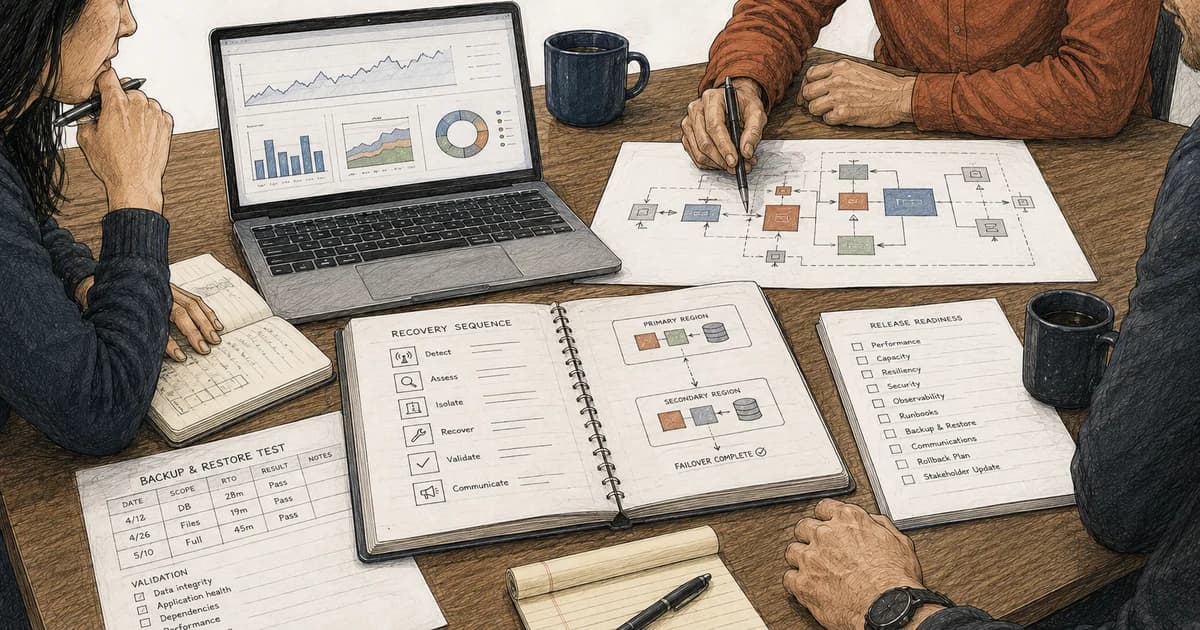
A feature can pass its acceptance test and still be unready for production.
The service may have no clear owner. The deployment may depend on a permanent credential. A retry may duplicate work. Alerts may describe infrastructure while users are failing. A schema migration may make rollback impossible. Support may have no way to reconcile a stuck transaction.
Production readiness is where architecture meets responsibility. It is evidence accumulated while the system is designed, built, tested, released, and operated.
Start with purpose and ownership
Name the business outcome, users, service owner, operational owner, data owner, and decision maker for risk. If ownership is shared, define the handoffs.
A team cannot design reliability or recovery without knowing the consequence of failure. “Highly available” describes an aspiration, not a testable requirement. State which workflows must continue, how long interruption is acceptable, how much data loss is tolerable, and who decides that the service is restored.
Review model
Review pillarsFour areas to review before release
Check how the workload will be owned, changed, monitored, and recovered as well as whether its features work.
- 01
Purpose and ownership
Business outcome, users, service owner, support model, and decision rights.
- 02
Quality attributes
Security, reliability, performance, cost, privacy, and data integrity targets.
- 03
Change and failure
Deployment, migration, dependency failures, degraded behavior, and recovery.
- 04
Operational evidence
Health model, telemetry, alerts, runbooks, drills, and acceptance criteria.
Readiness evidence
- Named owner and service level
- Tested failure behavior
- Telemetry tied to user impact
Release decision
- Known residual risks
- Runbooks and escalation path
- Evidence from recovery tests
Prioritize quality attributes
Security, reliability, performance, cost, operability, privacy, and maintainability all matter. They do not all receive the same weight in every workload.
Use concrete scenarios. “When the field link is unavailable for four hours, users can capture approved work locally and reconcile it after reconnection.” “When a downstream ERP is unavailable, accepted requests remain durable and support can see their state.” These statements can be designed and tested.
The Azure Well-Architected Framework organizes reviews around reliability, security, cost optimization, operational excellence, and performance efficiency. Its value is the tradeoff conversation, rather than a perfect score.
Review boundaries and authority
Trace critical workflows across user, application, service, database, queue, third party, and operational boundaries. At each crossing, identify identity, authorization, contract, validation, encryption, failure behavior, and audit.
Threat-model sensitive paths before release. Ask how an attacker or mistaken operator could cross a tenant, escalate privilege, poison an AI context, replay a request, exfiltrate data, or abuse a support function.
Design change and migration
Production readiness includes how the system changes. Build immutable artifacts, promote them through controlled environments, preview infrastructure changes, protect deployment identities, and define health gates.
Database and contract changes need coexistence. Prefer expand-and-contract migrations and versioned messages. A target state is incomplete without cutover, comparison, recovery, and retirement.
Make failure states visible
List dependencies and decide what happens when each slows, rejects, duplicates, or disappears. Use timeouts, bounded retries, circuit breakers, queues, idempotency, backpressure, and degraded modes where they fit the business semantics.
Every asynchronous workflow needs an operable state model. Users and support should know whether work is pending, accepted, failed, conflicted, or reconciled.
Build a health model
Logs, metrics, and traces become useful when they answer operational questions. Define user-visible success and connect it to service and dependency signals.
Each alert needs an owner, urgency, diagnostic path, and expected action. Remove alerts nobody acts on. Protect sensitive data in telemetry and control access to logs as production data.
Prove recovery
Backups are not proof of restore. Runbooks are not proof of recovery. Test them.
Rehearse service failover, credential revocation, queue replay, data restore, and rollback or roll-forward for the risks that matter. Record actual recovery time and unresolved gaps. Practice is part of architecture because it changes the design.
Include AI-specific evidence
For AI workloads, add versioned evaluation datasets, quality and safety criteria, groundedness and citation checks, prompt-injection tests, tool authorization, latency and cost limits, model and prompt versions, human-review policy, and production sampling.
Do not let a single average score hide an unacceptable failure category. The evaluation should mirror the task and its consequences.
A readiness review agenda
- Outcome, users, owners, and support model.
- Quality attributes and measurable targets.
- Architecture boundaries, contracts, identity, and data authority.
- Threat model and open security risks.
- Capacity, limits, performance, and cost envelope.
- Deployment, migration, and compatibility.
- Dependency failure and degraded behavior.
- Observability, alerts, dashboards, and audit.
- Backup, restore, rollback, roll-forward, and incident response.
- Acceptance evidence, exceptions, and the date to revisit them.
Record risks with an owner and due date. A review that produces only “approved” hides the most useful information.
Production readiness does not promise certainty. It is a disciplined argument, backed by current evidence, that the organization can deliver, support, change, and recover the workload responsibly.